Science
A self-driving microfluidic lab found brighter lead-free perovskite nanoplatelets in 12 hours
NC State's PoLARIS ran 120 closed-loop experiments in 12 hours on a six-element, lead-free nanomaterial, then used the same data to explain which ingredients mattered.
HackHoster Team · · 12 min read
At a glance
- PoLARIS, a droplet-based flow lab at North Carolina State University, ran 120 experiments in a single 12-hour autonomous campaign.
- It searched seven variables for Cs₂AgₓNa₁₋ₓInᵧBi₁₋ᵧCl₆ nanoplatelets, a lead-free material built from six elements.
- The best in-line brightness proxy rose from 17% to 30%, and the champion sample reached 45% quantum yield after purification.
- The campaign used about 30 mL of each precursor, with every reaction run inside a droplet of 5 to 15 microliters.
- A model trained on the data ranked cesium and indium chloride as the most important inputs and silver, sodium and bismuth as minor ones.
- The paper appeared in Nature Communications on May 4, 2026, with code for the platform deposited on Zenodo.
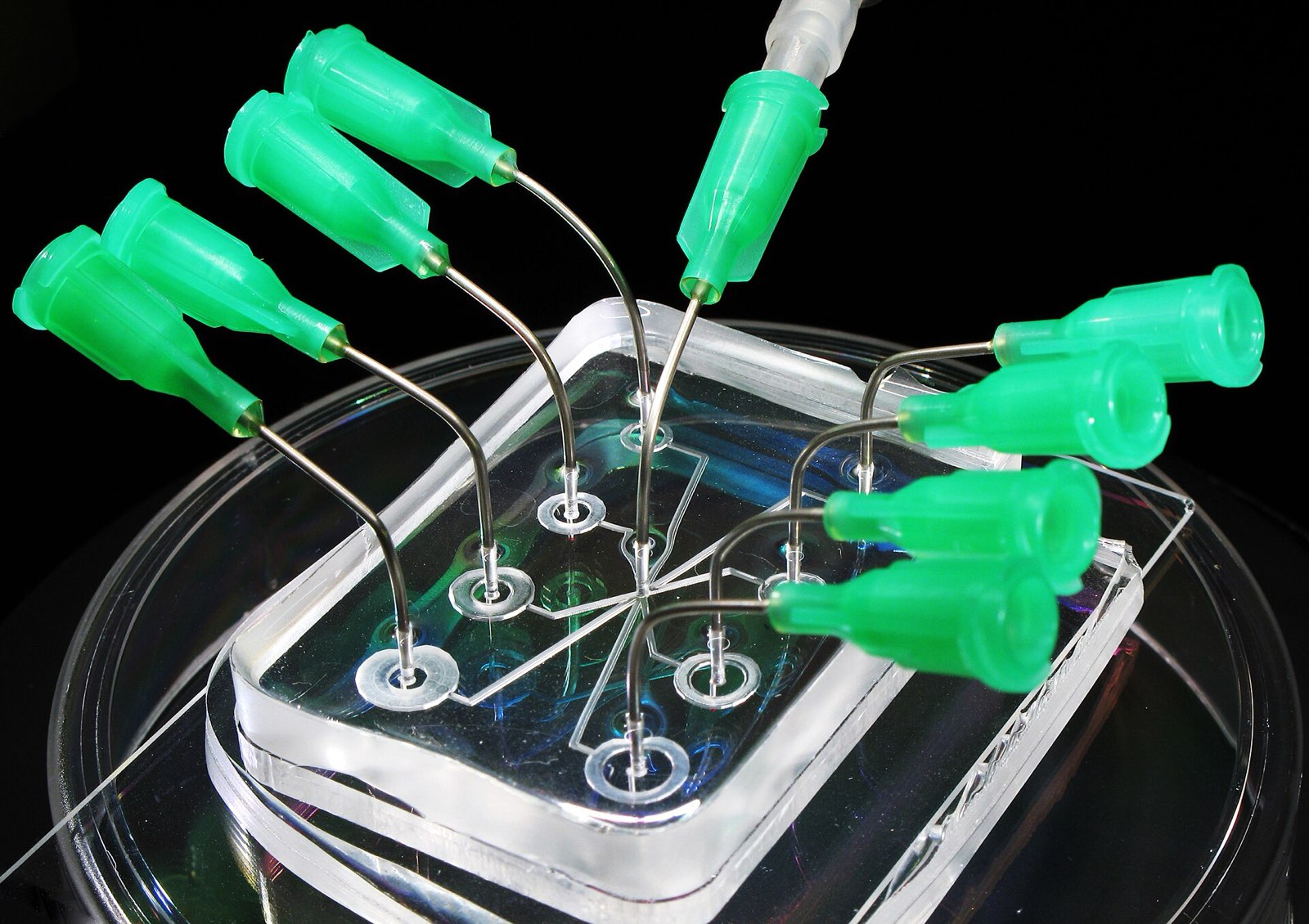
A team at North Carolina State University has published a self-driving laboratory that makes a nanomaterial, measures it while it is still flowing through a tube, and lets an optimization algorithm choose the next recipe. Nobody picks the experiments by hand. The system is called PoLARIS, short for Perovskite Laboratory for Autonomous Reaction Inference and Synthesis, and it is described in a Nature Communications paper published on May 4.
The target was a lead-free double perovskite in the form of nanoplatelets, thin sheet-like crystals containing up to six elements. In one 12-hour campaign PoLARIS ran 120 experiments and used about 30 mL of each precursor solution. Its in-line brightness measure rose from 17% to 30% over the run, and the best sample reached a photoluminescence quantum yield of 45% after purification, according to the paper. The same data then fed a model that ranked which ingredients actually control the result.
The work comes from the group of chemical engineer Milad Abolhasani, with doctoral student Junbin Li as first author and Ou Chen's chemistry group at Brown University as collaborators. The US National Science Foundation funded it.
What happened in one 12-hour run
The campaign had two phases. First, PoLARIS ran 80 experiments chosen by Latin hypercube sampling, a way of spreading test points evenly across a search space so that no region is left blank. Then it switched to 40 experiments picked by Bayesian optimization, five at a time, each batch informed by everything measured so far.
The search space had seven knobs: the flow rates of five precursors (cesium, silver, sodium, indium chloride and bismuth), the amount of the solvent 1-octadecene, and the reaction temperature. The material it was steering toward has the formula Cs₂AgₓNa₁₋ₓInᵧBi₁₋ᵧCl₆, where x and y can sit anywhere between 0 and 1. Every element added to a recipe is another axis to search, which is the core of the problem.
In the NC State release, Abolhasani describes the system as both a navigation aid for materials discovery and a small materials factory. He argues it goes beyond faster trial and error because each experiment improves a map of how composition and temperature drive performance. The release names photodetectors and solar fuel production as possible uses for this kind of safer optical nanomaterial.
Why lead-free perovskites are hard to make bright
A crystal structure with a long history
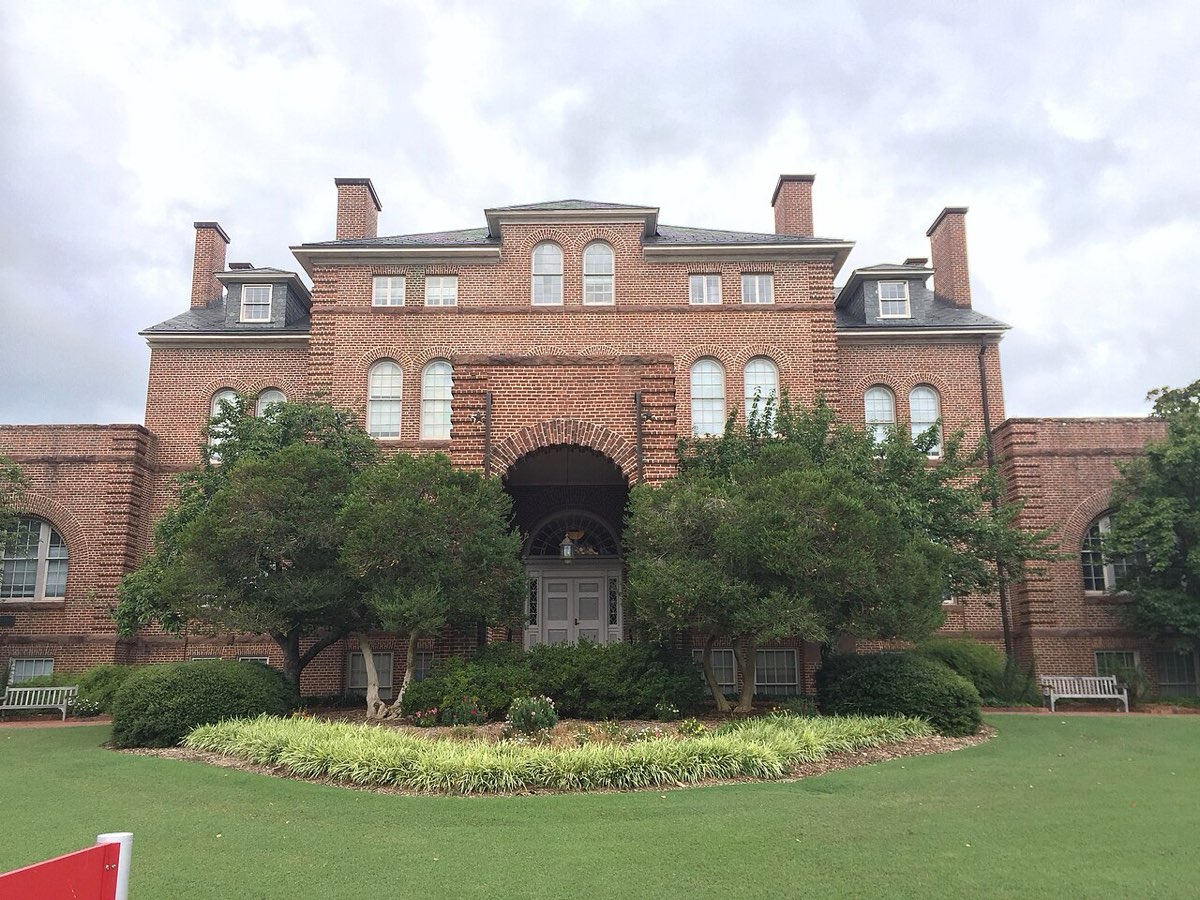
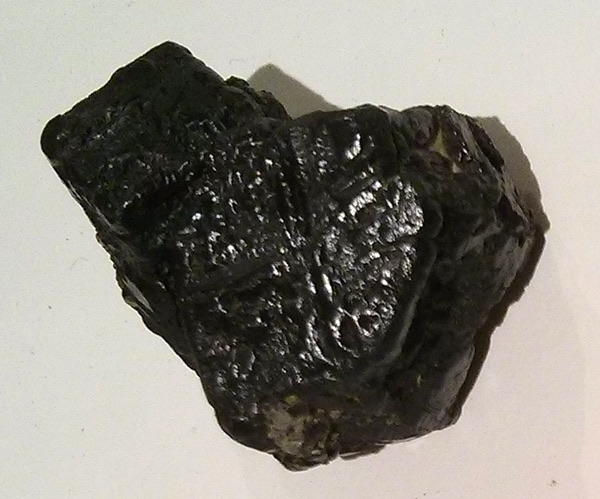
Perovskite was first a mineral. Gustav Rose found calcium titanium oxide, CaTiO₃, in Russia's Ural Mountains in 1839 and named it after the mineralogist L. A. Perovski. The name now covers a whole family of compounds with the general formula ABX₃: two positively charged ions of different sizes, A and B, and a negative ion X. The B ion sits inside an octahedron of X ions, and those octahedra share corners to build the crystal.
Halide perovskites, where X is a halogen such as iodine, bromine or chlorine, became a major research topic because charges move through them easily, which suits solar cells and light emitters. Many of the best-known examples, such as methylammonium lead iodide, contain lead. That is the reason groups like Abolhasani's look for alternatives: the paper describes double perovskites as especially attractive because of their lower toxicity compared with lead-based analogues.
Swapping lead for two metals
A double perovskite replaces the single B ion with two different ions that alternate in an ordered pattern, giving the formula A₂BB′X₆. In the PoLARIS material, the B sites are shared by silver or sodium on one side and indium or bismuth on the other, with cesium in the A position and chlorine as the halide.
The parent compound, Cs₂AgInCl₆, has a well-known flaw: its key optical transition is parity-forbidden, so it barely glows. A 2018 Nature paper by Jiajun Luo and colleagues showed how to get around that. Mixing sodium into the silver sites broke the symmetry that kept the transition dark. Their best bulk material, Cs₂(Ag₀.₆₀Na₀.₄₀)InCl₆ with a trace of bismuth (0.04%), emitted warm white light with a quantum yield of roughly 85% and ran in a prototype LED for more than 1,000 hours, as Phys.org reported at the time. The light comes from self-trapped excitons, electron and hole pairs that distort the crystal lattice around themselves.
That result was for bulk powder. Making the same family as nanoplatelets brings in more variables. The PoLARIS recipes also involve oleic acid and oleylamine ligands and a solvent, and the authors saw excess precursor produce secondary phases and defects. The paper describes the effects of the six elements as nonlinear and interacting, the kind of tangled space where one-at-a-time manual experiments are slow and easy to get wrong.
Photoluminescence quantum yield (PLQY) is the share of absorbed photons that a material gives back as emitted light. A PLQY of 45% means that for every 100 photons the nanoplatelets absorb, about 45 come back out as light. Measuring it properly needs an integrating sphere, which is why PoLARIS used a faster stand-in during the campaign.
How the rig works
Droplets as tiny reactors
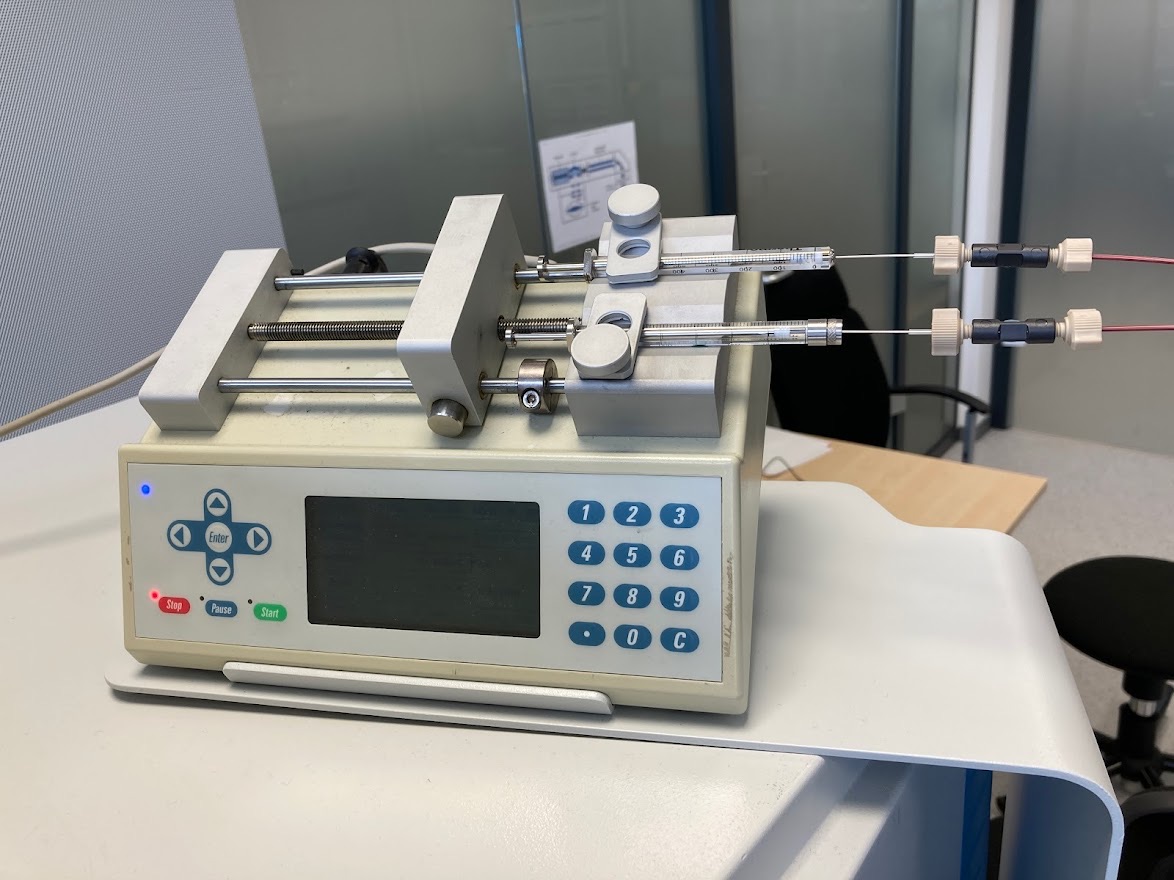
The paper describes the hardware in enough detail to sketch it. Seven computer-controlled Chemyx Fusion 6000 syringe pumps feed precursor solutions into a mixing point. A T-junction then cuts the combined stream into droplets of 5 to 15 microliters, carried along by a perfluorinated oil. Each droplet behaves as its own sealed reactor, so one recipe does not bleed into the next.
The droplets travel through a spiral channel machined into an aluminum block and heated by five cartridge heaters under PID control. The maximum temperature is about 220 °C, a ceiling set by the heat tolerance of the PFA tubing. Because seven streams share one line, each pump is limited to 25 to 60 microliters per minute.
As the droplets leave the reactor, fiber-coupled spectrometers record absorption, using a broadband lamp, and fluorescence, using a 365 nm LED. Results go to a cloud database. The team reports that repeat measurements of peak intensity, absorbance and integrated emission varied by only 2.1% to 2.4%, and that the system held steady at about 4% variation over an hour of continuous production.
The decision loop
The software side will look familiar to anyone who has tuned hyperparameters. Bayesian optimization is a method for finding the best setting of an expensive black-box function, one where every evaluation costs real time or material. Its roots go back to work by Harold Kushner in 1964 and Jonas Mockus in the 1970s, and it became widely used after the 1998 Efficient Global Optimization algorithm of Jones, Schonlau and Welch. It tends to work best with fewer than about 20 variables, which makes a seven-knob chemistry problem a comfortable fit.
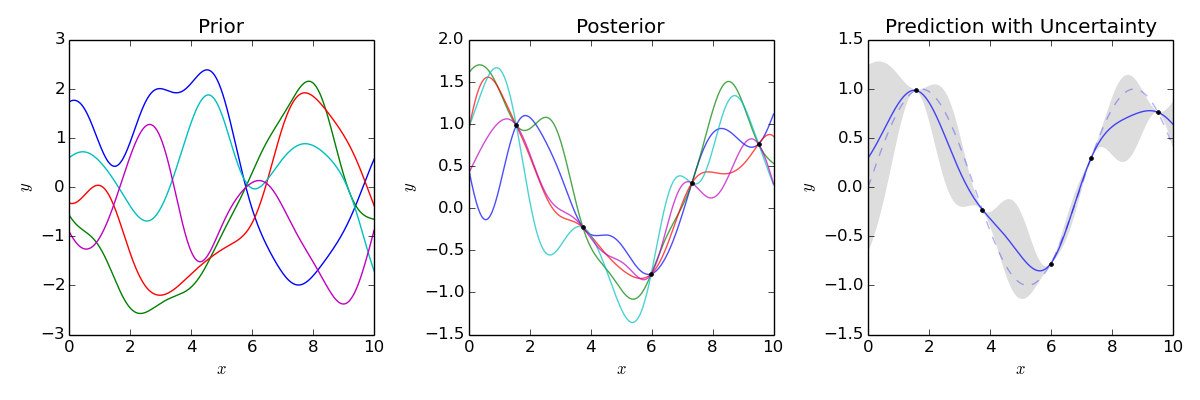
The method needs two parts. A surrogate model, here a Gaussian process regression, predicts the outcome at untested points and also says how unsure it is. An acquisition function then turns those predictions into a choice of what to try next. PoLARIS built each batch of five from two rules: four candidates from a log-transformed expected improvement policy, which favors points likely to beat the current best, and one from an upper confidence bound rule, which rewards uncertainty and so pushes the search into less-explored regions. Proposals that broke the hardware limits were repaired before they ran.
Measuring brightness without stopping
The objective the loop optimized was not PLQY itself. True quantum yield requires an offline measurement, so the system calculated the integrated fluorescence signal divided by an estimate of the light each droplet absorbed, right in the flow line. The authors report that this proxy tracked offline PLQY closely within the region they explored, and they confirmed the champion sample on an integrating-sphere instrument afterward.
The numbers
| Measure | Value reported in the paper |
|---|---|
| Experiments in the campaign | 120 (80 space-filling, 40 Bayesian optimization) |
| Campaign length | 12 hours |
| Precursor used | About 30 mL per precursor |
| Droplet volume | 5 to 15 µL |
| Search variables | 7 (five precursors, solvent, temperature) |
| Temperature ceiling | About 220 °C |
| Best PLQY proxy, space-filling phase | 26.4% |
| Best PLQY proxy, end of campaign | 30% |
| Champion PLQY, measured offline | 28% crude, 45% purified |
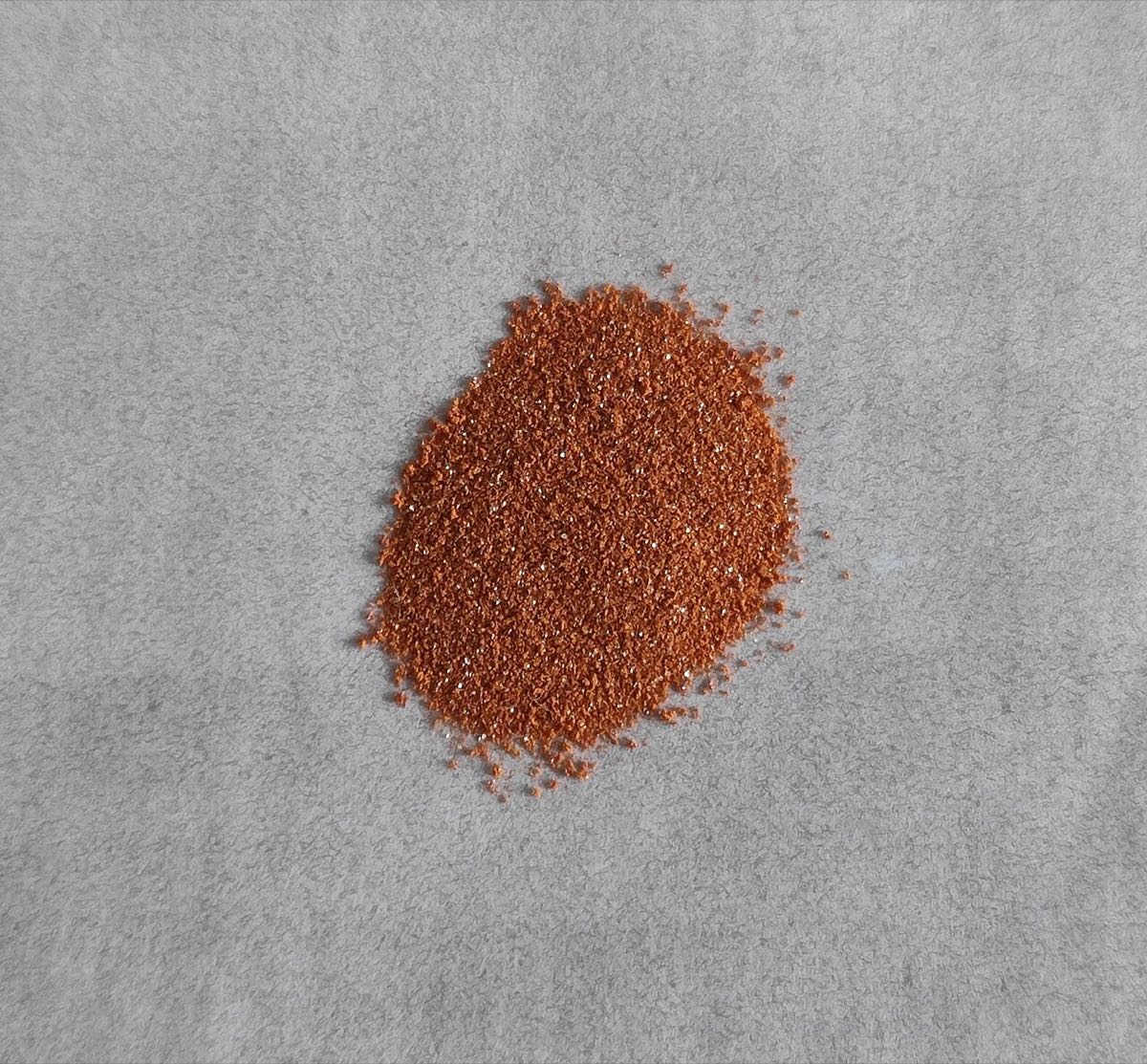
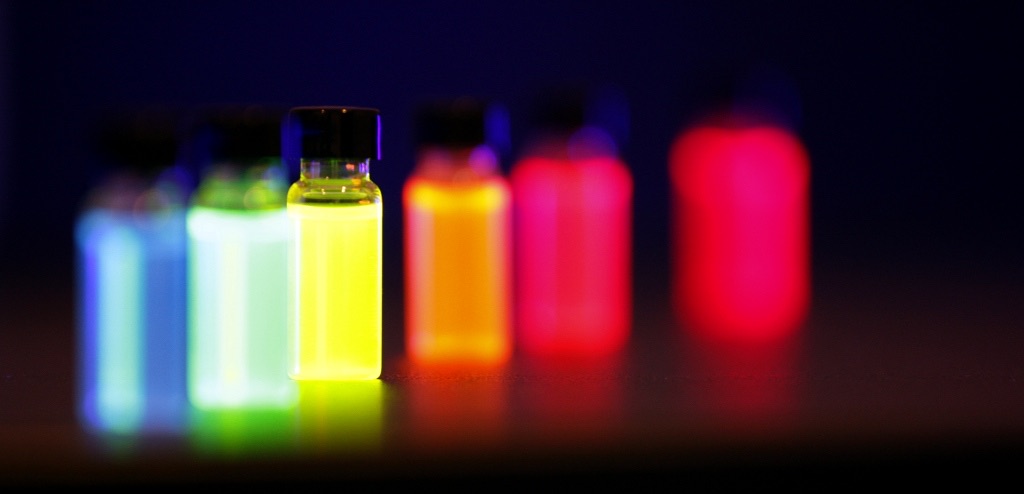
| Emission peak of champion | About 610 nm (orange-red) |
| Model fit during the loop | R² above 0.99 |
| Model fit, 10-fold cross-validation | R² of 0.71 |
Two lines in that table deserve a second look. The best proxy value found during the 80 space-filling runs was already 26.4%, so the 40 Bayesian optimization runs lifted the best result by a few points rather than producing the whole jump from 17%. And the model's near-perfect fit during the loop dropped to an R² of 0.71 under 10-fold cross-validation, a more honest estimate of how well it predicts recipes it has not seen.
The champion sample's composition, measured by electron microscopy with elemental mapping, was mostly cesium and chlorine, with silver, sodium and indium at around 6% to 7% each and bismuth at about 0.3%. X-ray diffraction showed the double perovskite phase with no detectable secondary phases. Its emission was broad, a full width of 216 nm, which is typical of the self-trapped exciton mechanism. The authors purified it by centrifuging twice and redispersing it in toluene.
Learning chemistry, not just a recipe
The "reaction inference" part of the name is about mechanisms. Here PoLARIS builds on the group's earlier work. In July 2025 Abolhasani's lab reported dynamic flow experiments in Nature Chemical Engineering: instead of holding each recipe fixed until the reaction finished, the system varied the mixture continuously and recorded spectra every half second. NC State said that approach produced at least ten times more data than steady-state experiments, tested on cadmium selenide quantum dots.
PoLARIS applied the same trick to the perovskite chemistry. It ramped one precursor's flow rate slowly while holding everything else steady and logged the spectra as the composition changed.
- Cesium: as the cesium flow fell from 60 to 25 microliters per minute, emission collapsed below about 30, the peak shifted red and then blue, and the emission band widened. The authors read that as cesium vacancies forming and creating defects that trap energy.
- Indium chloride: brightness rose quickly at low flow, peaked at 35 to 40 microliters per minute, and fell again at higher rates. The authors attribute the drop to excess halide forming defect complexes and changing how the elements are incorporated.
The team then treated the trained Gaussian process as a digital twin of the reaction and ran a SHAP analysis on it, which attributes each prediction to the inputs that drove it. Cesium ranked first, indium chloride second and temperature third. The solvent had a modest effect, and silver, sodium and bismuth mattered much less within the explored range. The model's reading is that more cesium, more indium chloride and higher temperature tend to give brighter platelets.
That ranking may be the most reusable output of the study. It tells the next group which knobs deserve their limited experimental budget, and which ones can probably be held fixed.
Caveats and open questions
The headline numbers need context before anyone repeats them.
- The loop optimized a proxy. The 45% figure came after offline purification of the best candidate. During the run the system chased the in-line ratio, which matched offline PLQY in the region tested but is not the same measurement.
- Shape was invisible. The rig could not track nanoplatelet size or thickness during the campaign. The authors note the proxy assumes a roughly constant absorption coefficient, and that a large change in particle shape could break that assumption.
- Hardware limits shaped the search. The 220 °C ceiling and the 25 to 60 microliter per minute range per stream cut off parts of the space that a flask chemist could reach.
- High-brightness predictions are the weakest. The paper reports that the model's errors concentrate at the high end, where data is sparse.
- No speed comparison. The paper does not compare its time or material use against a manual campaign, so any "X times faster than a human" claim is not the authors'.
- One material, one run. The results come from a single 12-hour campaign on one material family.
Self-driving labs have also had a public lesson in verification. In 2023, the A-Lab at Lawrence Berkeley National Laboratory reported making more than 40 new materials autonomously. In early 2024 outside chemists published an analysis arguing that none of them were new, according to Chemistry World. PoLARIS makes a narrower claim, an optimized recipe and a ranked list of factors, and it backs the champion with offline XRD, electron microscopy and integrating-sphere data. Still, the A-Lab dispute is a reminder that automated characterization needs human checks before the conclusions travel.
Key caveat: a 45% quantum yield is a large step for a lead-free nanomaterial, but it is not yet a device. The paper reports optical measurements on dispersed nanoplatelets. Long-term stability and performance inside a working LED or photodetector were not part of the study.
What builders can borrow
The software pattern is ordinary and reproducible, which is the good news. A space-filling start, a Gaussian process surrogate and batched acquisition that mixes exploitation with a little exploration will work on many slow, noisy measurements that have nothing to do with chemistry. The authors put their data processing and autonomous experimentation code on Zenodo. On the open-source side, BoTorch is a Bayesian optimization library built on PyTorch, and Ax is Meta's adaptive experimentation platform for running such loops.
For a hackathon team, good targets are anything where each evaluation costs minutes and you can name a number to maximize:
- Fabrication settings: print speed and temperature for a 3D printer part, scored by a measured dimension.
- Model configuration: learning rate, batch size and context length for a fine-tune, scored on a held-out set.
- Lab-on-a-budget chemistry: dye mixtures or pH titrations with a cheap USB spectrometer, scored by absorbance at one wavelength.
- Simulation: reactor or circuit parameters in a simulator, where you can also measure how many evaluations the loop saves.
Three habits from the paper transfer directly. Start with a space-filling batch rather than a guess, so the surrogate has a fair picture of the space. Keep one exploration slot in each batch, because a loop that only exploits can stall on a local peak. And, after the run, ask the trained model which inputs mattered, because that answer is often worth more than the single best point.
Practical tip: if your real objective is expensive to measure, do what PoLARIS did. Pick a cheap proxy, check that it tracks the real number on a handful of points before trusting it, and re-measure the winner properly at the end.
What to watch
As of early May 2026, the clearest open questions come from the paper's own limits. One is whether the group adds in-line size or thickness monitoring, which would close the gap the authors flag in their brightness proxy. Another is whether these nanoplatelets reach devices: the NC State release mentions photodetectors and solar fuel production, but no device data has been published. A third is whether other labs reuse the Zenodo code on different multi-element nanocrystals. That would show whether PoLARIS is a general tool or a carefully tuned instrument for one chemistry. The quality of that reuse, more than the 12-hour figure, will decide how much this paper matters.
Sources
- AI-powered lab discovers brighter lead-free nanomaterials in 12 hours (NC State News, May 4, 2026)
- Autonomous microfluidic experimentation for exploring reaction inference and synthesizing double perovskite nanoplatelets (Li et al., Nature Communications, via PMC)
- Researchers hit fast forward on materials discovery with self-driving labs (NC State News, July 2025)
- Efficient and stable emission of warm white light from lead-free halide double perovskites (Phys.org, 2018)
- Perovskite (structure) (Wikipedia)
- Bayesian optimization (Wikipedia)
- New analysis raises doubts over autonomous lab's materials discoveries (Chemistry World, 2024)
More from the blog
Science ·
Anthropic's wet lab reports a CRISPR-like enzyme family surfaced by Claude agents
About 950 Claude agent sessions mined sequence data for reverse transcriptases and flagged ART, a phage system with CRISPR-like repeats. Humans ran the experiments, and its function is unknown.
11 min read
Science ·
Six proteomic aging clocks read younger in rentosertib's lung fibrosis trial
A Nature Biotechnology study ran six protein-based aging clocks on serum from Insilico's IPF drug trial. The signal is consistent but small, early and hard to separate from the lung disease.
11 min read
Science ·
MIT and Oak Ridge's CrysVCD builds charge balance into AI crystal generation
A small transformer writes charge-balanced formulas before a diffusion model builds the crystal. Tuned for stability, 85% of outputs were predicted metastable. The code is open.
10 min read