Science
A deep-learning scheduler planned observing nights on the Blanco 4-meter telescope in Chile
An AI trained on years of Dark Energy Survey decisions planned and re-planned observations for the 570-megapixel Dark Energy Camera, performing about as well as human schedulers.
HackHoster Team · · 10 min read
At a glance
- On July 31, 2026, SkAI researchers said a deep-learning scheduler had planned and managed observations on a national facility for the first time.
- The system drove the 570-megapixel Dark Energy Camera on the NSF Víctor M. Blanco 4-meter Telescope at Cerro Tololo in Chile during two runs this spring and summer.
- NOIRLab says the model was trained on 13 years of historical observing data, learning to predict the next pointing from past decisions.
- Co-lead Alex Drlica-Wagner rates its performance as comparable to a human's, and the team's next goal is to beat human schedulers.
- No paper, metrics or model details have been published yet, so the parity claim rests on the team's own assessment.
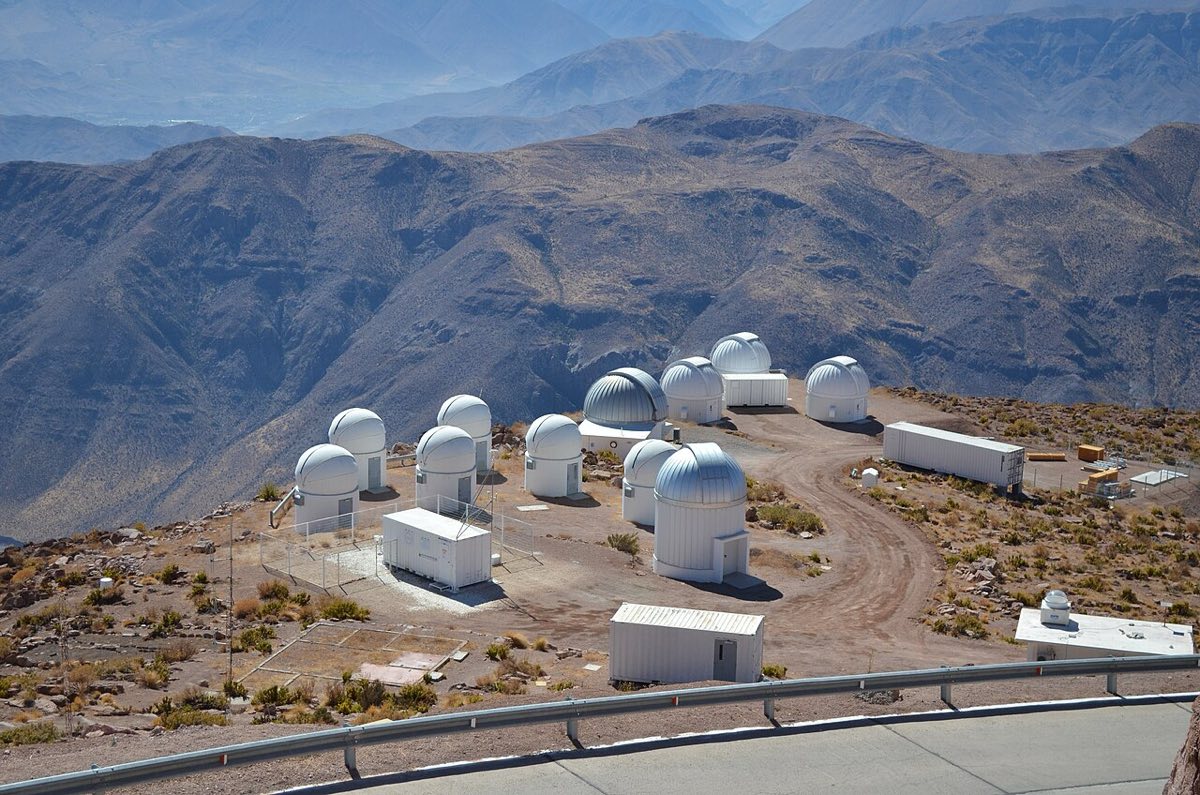
For the first time, an AI system has planned and managed observations on a national astronomy facility, according to an announcement on July 31 from Northwestern University, the University of Chicago, Fermilab and NSF NOIRLab. Researchers from the NSF–Simons Foundation AI Institute for the Sky (SkAI) used a deep-learning scheduler to drive the 570-megapixel Dark Energy Camera (DECam) on the NSF Víctor M. Blanco 4-meter Telescope at Cerro Tololo in Chile. The system produced an observing plan for the night and revised it as the weather and sky changed.
It completed two observing runs this spring and summer. The goal for this first deployment was to match human schedulers, and the team says it did. Co-lead Alex Drlica-Wagner of UChicago and Fermilab described its performance as comparable to a human's and said the next step is to make it better than one. SkAI postdoc Paul Chichura, UChicago PhD student Rachel Hur and NOIRLab scientist Guillermo Damke carried out the on-sky deployment, and Northwestern computer scientist Aravindan Vijayaraghavan co-led the project.
This article explains the scheduling problem, the instrument, how the Dark Energy Survey scheduled its nights before this work, how the new model learned, what has not been published, and what anyone building AI for operational decisions can take from it.
The scheduling problem
Every night, someone has to decide where a large telescope points next. The answer depends on the weather, how bright the moonlight is, and shifting atmospheric conditions. According to NOIRLab, a bad choice produces blurry images or frames washed out by moonlight, which makes faint objects harder to detect. Astronomers sometimes wait months for time on a major telescope, so a failed observation can take months to repeat.
Drlica-Wagner's argument is about efficiency for the whole field. "Large telescopes are national or international resources," he said, and he noted that many astronomers compete for limited time. If everyone used their time more efficiently, he argued, the community could do more science. He also framed scheduling as a technical chore: automating it would leave astronomers more time for scientific questions.
It is a hard problem because the inputs interact. Seeing, the blurring caused by atmospheric turbulence, varies on short time scales, and the DES team found those short-term swings larger than the errors in its simple seeing models. Image quality gets worse as a telescope points closer to the horizon, through more air. Moonlight brightens the sky, more in some filters than others. A survey also has long-term goals, such as covering its whole footprint evenly or revisiting certain fields on a fixed cadence, so a choice that looks best right now can paint the survey into a corner months later.
The instrument: Blanco and DECam
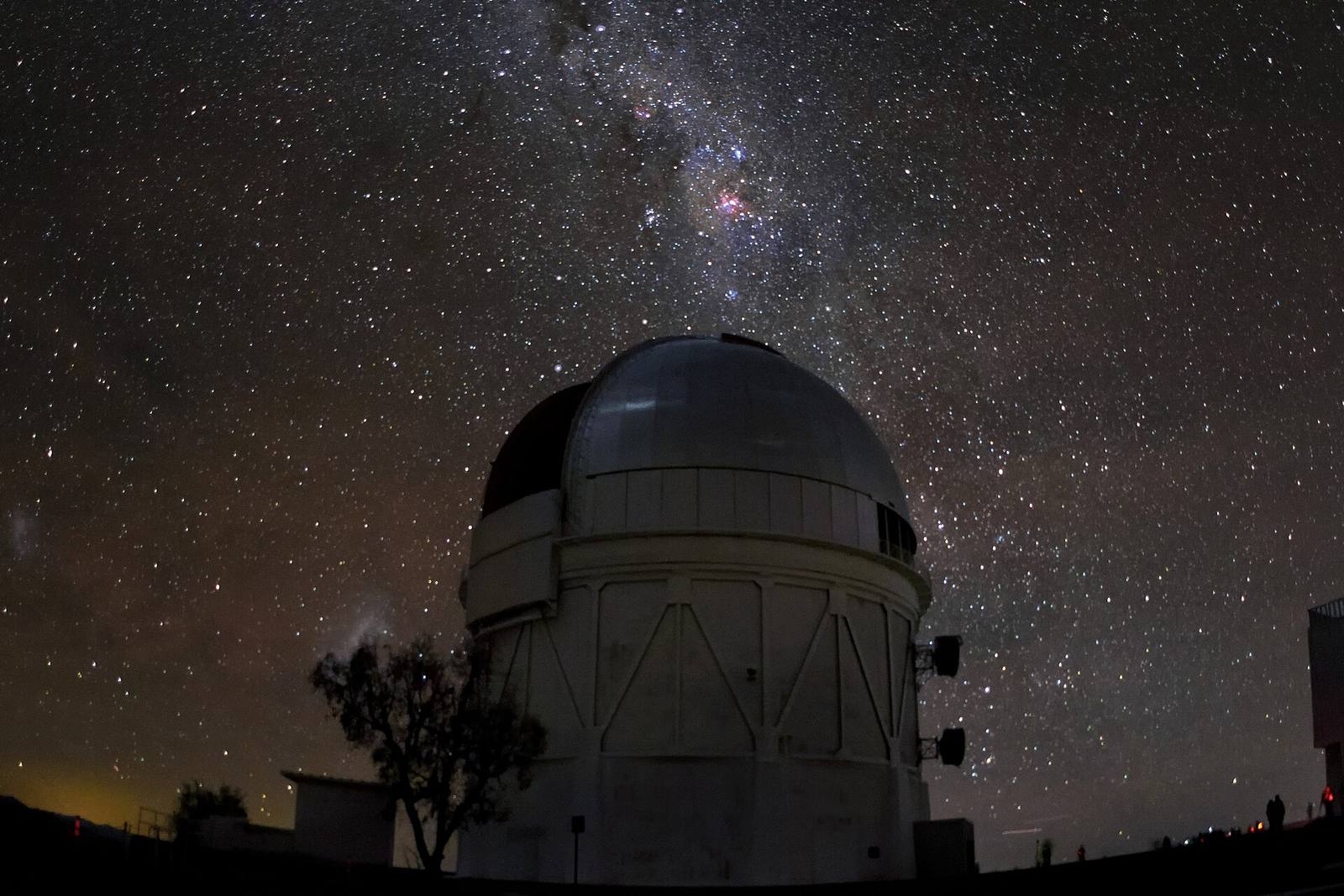
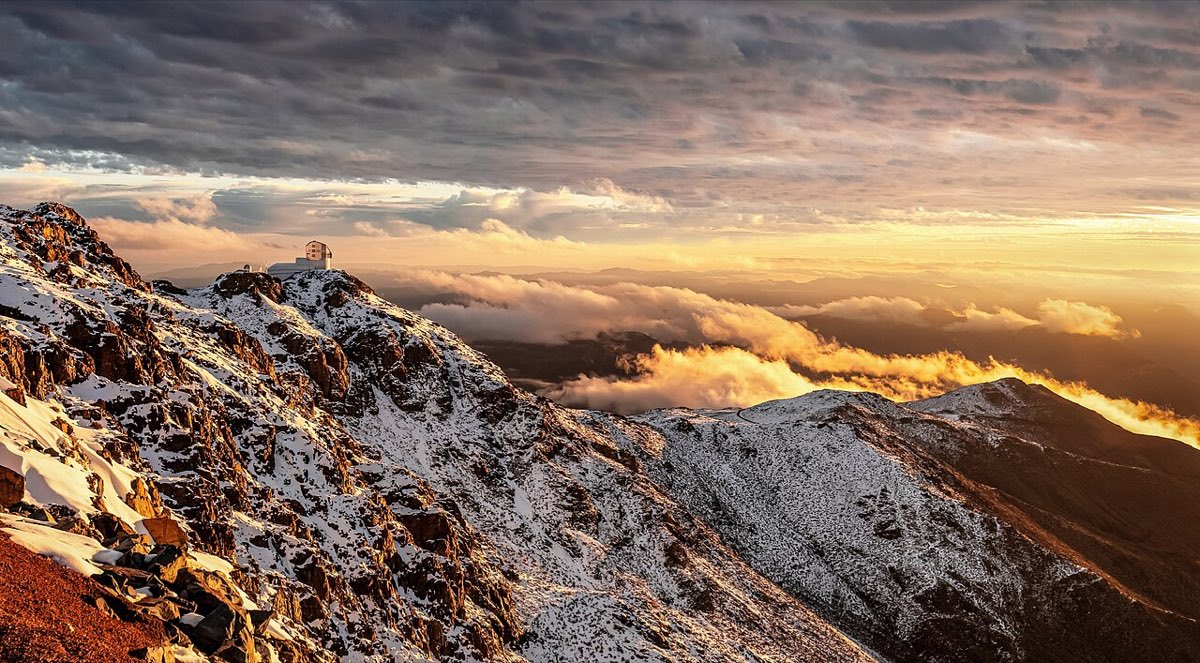
The Blanco telescope has been on Cerro Tololo since 1976, at an altitude of about 2,207 meters. It was the largest optical telescope in the Southern Hemisphere until 1998, and it was named in 1995 for the Puerto Rican astronomer Víctor Manuel Blanco. NOIRLab calls it one of the world's most productive astronomical facilities and notes that its telescope control software has been continuously upgraded.
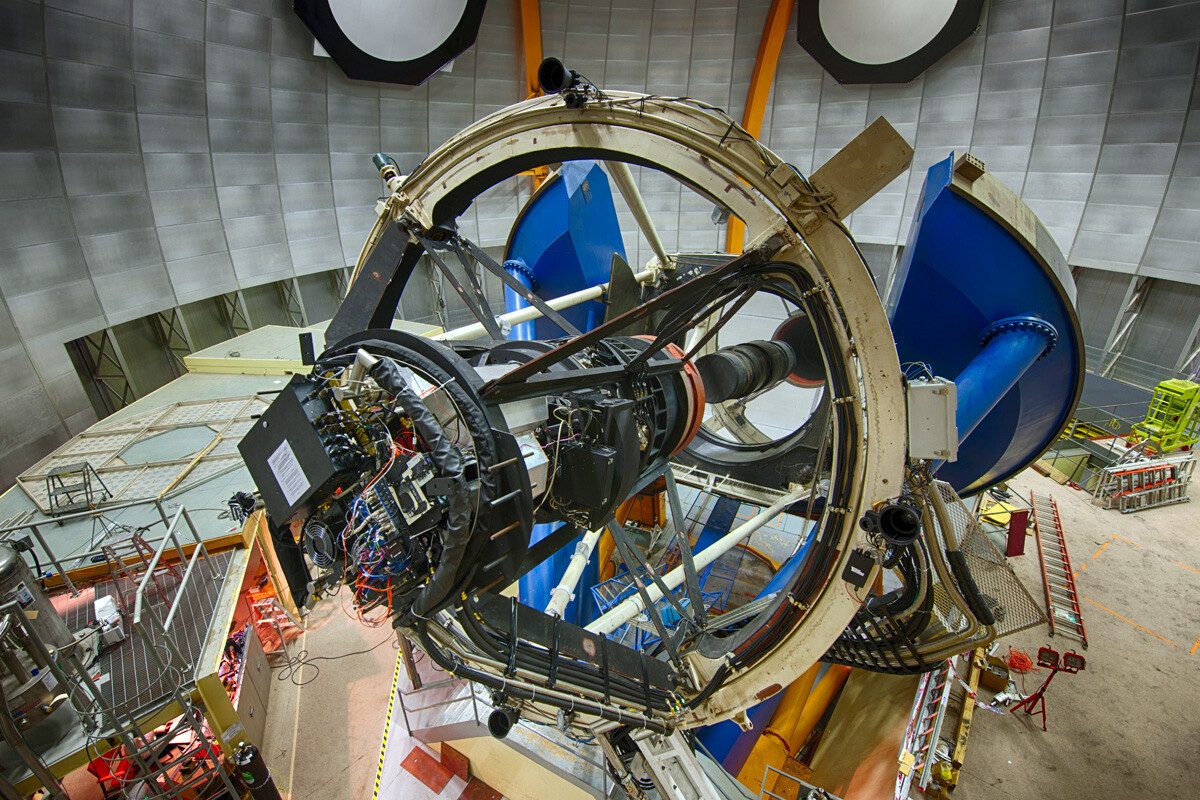
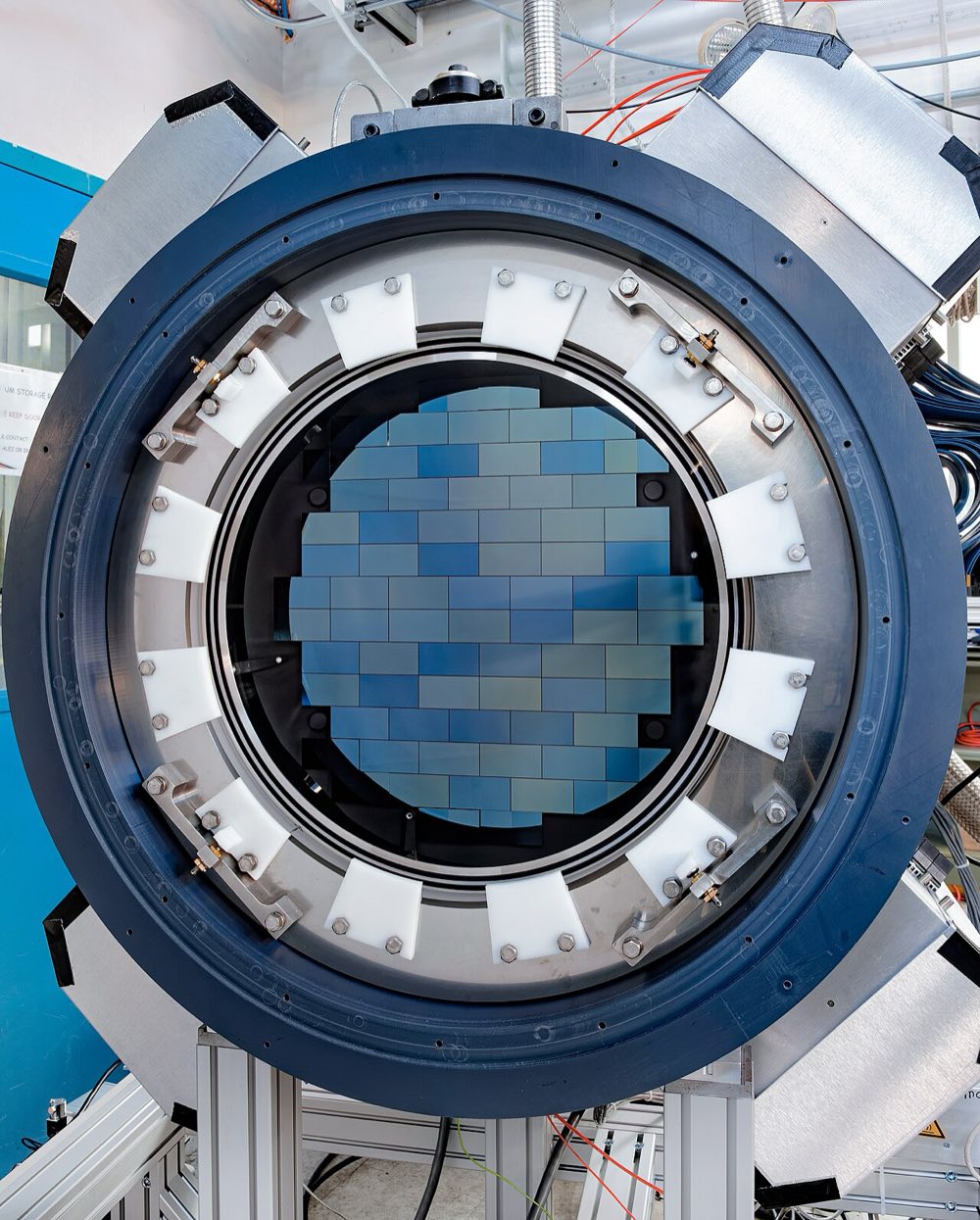
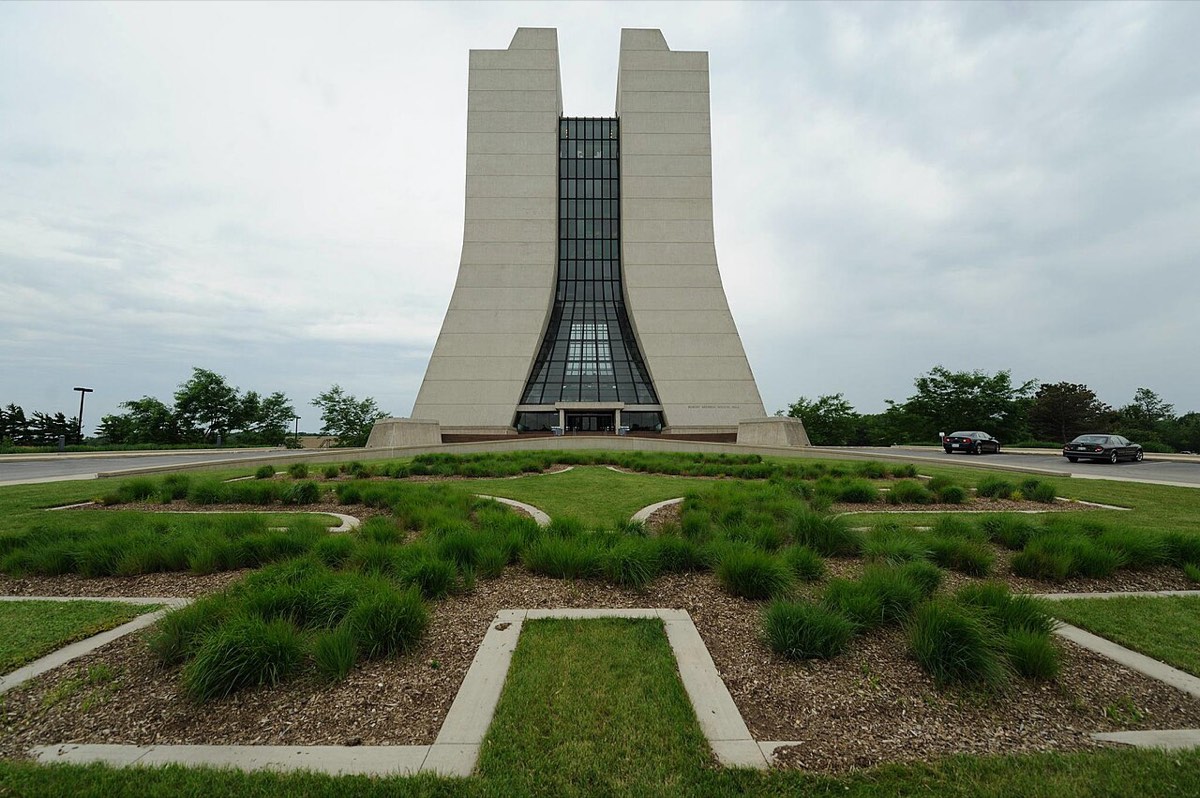
Its main instrument is the Dark Energy Camera. DECam was designed for the Dark Energy Survey, funded by the US Department of Energy, and built and tested at Fermilab. It saw first light in September 2012.
| Specification | Value |
|---|---|
| Telescope aperture | 4 meters |
| Site altitude | About 2,207 m, Cerro Tololo, Chile |
| Telescope first light | 1976 |
| DECam science sensors | 62 CCDs of 2048 × 4096 pixels, 520 megapixels |
| DECam total | 570 megapixels, including 12 guide and focus CCDs |
| Field of view | 2.2° across, about 3 square degrees per exposure |
| Filters | u, g, r, i, z and Y, from 340 to 1,070 nm |
| Camera mass and temperature | About 4 tons, sensors cooled to about −100 °C |
Sources: Wikipedia entries for the Blanco telescope and the Dark Energy Survey; NOIRLab.
A camera that covers 3 square degrees at once makes scheduling decisions expensive. Each pointing commits a large slice of sky and a couple of minutes of telescope time, and the next pointing has to account for how far the telescope must slew.
How the Dark Energy Survey scheduled its nights
The Dark Energy Survey ran from 2013 to 2019 and mapped hundreds of millions of galaxies to study why the universe's expansion is speeding up. A 2019 paper by Eric Neilsen and colleagues, including Drlica-Wagner, describes how it chose what to observe. The survey combined a 5,000-square-degree wide survey with a weekly time-domain survey of 10 fields used to find supernovae. It was planned for 525 nights over five years, and a sixth year of 52 nights brought the total to 577.
The survey's scheduler was a program called obstac. The paper frames it as a Markov decision process: obstac reads the state of the survey, the instrument and the environment, picks an action, either one wide-survey exposure or one sequence of supernova exposures, and repeats when the next exposure is needed. The choice itself came from a hand-built decision tree with hard limits and preferences:
| obstac rule | Setting during DES |
|---|---|
| Airmass limit, wide survey | 1.4 |
| Sky brightness limit, wide survey | 1 magnitude per square arcsecond brighter than full dark |
| Distance from the Moon | At least 30° |
| Supernova cadence | Any supernova field not observed for 7 days takes priority |
| Slew preference | Pointings reachable with slews under 4° |
| Wide-survey exposures | 90 seconds in g, r, i and z, ten tilings of the footprint |
Source: Neilsen et al., 2019.
The moon rules show how much expert knowledge was baked in. The paper says observing in the g and r filters was generally futile with the Moon up, so most dark time went to those filters, while the redder filters were mostly observed in moonlit time. Near the full moons of September and December, the cadence of the supernova fields needed careful hand-tuned intervention.
People stayed in the loop. Before most nights, observers and survey scientists met at 4 p.m. Chilean time to review data quality, the weather forecast and simulations of how obstac would behave. After each night, data management flagged exposures that failed quality cuts so obstac would repeat them. Humans could also add exposures to a block list, most often to skip fields contaminated by scattered light from bright stars. But on most nights, the paper says, the instruction to the observing staff was to switch obstac on and let it run all night.
Imitation learning: training a model to copy an expert's decisions. You log what the expert saw and what they chose, then train a supervised model to predict the choice from the situation. It needs no hand-written reward function, but it can only be as good as the decisions it copies.
How the new model learned
The SkAI team did not encode those rules. According to Drlica-Wagner, they showed a deep-learning model where the telescope was pointing at one moment, asked it to predict the next observation, compared that guess with what astronomers actually chose, and corrected its mistakes over many rounds of historical Dark Energy Survey observations. NOIRLab describes the training data as 13 years of observing history. The model was never told how the Moon's brightness or atmospheric conditions affect image quality. It picked up those patterns from the decisions in the logs.
That is imitation learning. It is a practical starting point, because the logs already exist and no one has to write down what a good night looks like as a formula. It also explains why the first milestone was parity: a model trained to copy past decisions learns how those decisions were made, and it has no built-in way to discover better ones.
There is a subtlety in the human baseline. Because DES ran obstac on most nights, the decisions in the DES logs likely reflect obstac's rules as much as anyone's moment-to-moment judgment, along with the humans who configured it, overrode it and scheduled repeats of failed exposures. The announcement does not say how the 13 years break down, given that DES itself observed for six seasons, or whether non-DES programs are in the training set. Either way, the baseline is a mix of software and expert judgment, not people alone.
Vijayaraghavan framed the work as bringing ideas from AI and reinforcement learning to telescope scheduling, where every decision balances changing conditions against scarce observing time. He added that scheduling for astronomical surveys raises new machine-learning problems. The team's stated next goal is to go beyond copying human choices and explore observing strategies people might never try, which points toward training against an objective rather than against logs.
Where this fits among telescope schedulers
Automated schedulers are not new. obstac automated DES exposure selection a decade ago. For the Vera C. Rubin Observatory, a 2018 paper by Elahesadat Naghib and colleagues introduced a Feature-Based scheduler: an automated, proposal-free decision algorithm designed to be controllable, adjustable to changing mission goals, and quick to recover from interruptions. What is new in the SkAI work is a learned policy, trained from logs instead of written by hand, running a national facility on sky.
| Scheduler | Approach | Where |
|---|---|---|
| obstac | Hand-built decision tree inside a Markov decision process framing, hard limits on airmass, sky brightness and Moon distance | Dark Energy Survey on Blanco, 2013–2019 |
| Feature-Based scheduler | Mathematical framework for automated, proposal-free decisions, tunable and recoverable | Developed for Rubin's Legacy Survey of Space and Time |
| SkAI scheduler | Deep-learning model trained to predict the next observation from historical logs, re-planning in real time | Blanco with DECam, two runs in 2026 |
Sources: Neilsen et al., 2019; Naghib et al., 2018; Northwestern and NOIRLab announcements.
The researchers point to Rubin as a reason the work matters now. Rubin, on Cerro Pachón in Chile, has an 8.4-meter mirror and a 3.2-gigapixel camera, released its first images in June 2025, and can generate up to 10 million alerts a night about objects that change in brightness or position. The team argues that as Rubin produces data at that scale, intelligent schedulers could help companion telescopes respond more efficiently.
SkAI itself is young. Northwestern announced the institute in September 2024 as a $20 million effort funded jointly by the NSF and the Simons Foundation, led by Northwestern with the University of Chicago, the University of Illinois Urbana-Champaign and the National Center for Supercomputing Applications as core partners, and astrophysicist Vicky Kalogera as director. Processing data from Rubin's survey was one of its stated goals from the start.
What has not been published yet
The announcement leaves out the numbers a builder would want:
- Scale. How many nights the two runs covered, and how many exposures the AI chose.
- Metrics. How performance was compared with human schedulers. DES had its own measure of exposure quality, an effective exposure time it called τ, but the announcement does not say which metric the team used.
- Model. The architecture, the input features, and how weather and sky data reach the model in real time.
- Re-planning. How often the live re-planning changed the plan, and what happens when the model proposes something unsafe or pointless.
No paper accompanies the announcement so far, so the claim of parity with human schedulers rests on the team's own assessment. Drlica-Wagner named a different result as one of the main achievements: the team built all the infrastructure needed to run a self-driving telescope at a national observatory. That fits a familiar pattern in applied machine learning, where connecting a model to a production control system is often harder than training it.
The key caveat: parity with human schedulers is the team's qualitative judgment from two observing runs. Until metrics are published, treat it as a promising deployment report rather than a measured result.
What builders can take from it
For anyone building agents for operational work, such as on-call triage, warehouse routing or job scheduling, the SkAI sequence is worth copying. Start from logs of expert decisions, train a model to reach parity, deploy it on the real system, and only then try to beat the baseline. The team has finished the first three steps.
A few practical lessons follow from the details above:
- Know what your logs encode. DES logs reflect a rule-based scheduler plus human overrides. Your support-ticket or dispatch logs may reflect an old heuristic just as much as human judgment. Imitation will reproduce both.
- Keep hard limits outside the model. obstac's airmass, sky-brightness and Moon-distance limits are the kind of constraints worth enforcing in plain code around a learned policy, so a strange prediction can't waste an expensive resource.
- Keep a human override. DES let people block specific exposures for reasons the scheduler couldn't see. A learned system needs the same escape hatch.
- Define the metric before you try to beat the baseline. DES scored exposures by an effective exposure time. Without a comparable score, a claim to beat human schedulers can't be tested.
- Simulate before you deploy. DES simulated each upcoming night with obstac before observing. A simulator built from historical logs lets you test a learned policy without spending real resources.
Practical tip: if you have a log of decisions, you have a training set. A hackathon-sized version of this project is a next-action predictor trained on your own event logs, wrapped in hard constraints, and run in shadow mode next to the existing system before it ever acts.
What to watch next
As of July 31, the next milestones are clear. A paper with metrics, architecture and night counts would turn the parity claim into something others can check. The team's stated plan is to move from imitation toward strategies humans might not try, likely with reinforcement learning or a similar objective-driven method. With Rubin producing alerts at scale, the test that matters will be whether learned schedulers on companion telescopes like Blanco can turn those alerts into better follow-up observations than rule-based systems manage today.
Sources
- First AI-driven telescope goes stargazing (Northwestern University)
- First AI-driven Telescope Goes Stargazing (NSF NOIRLab announcement ann26016)
- Dark Energy Survey's Observation Strategy, Tactics, and Exposure Scheduler (arXiv, 2019)
- A Framework for Telescope Schedulers, with Applications to the Large Synoptic Survey Telescope (arXiv, 2018)
- Northwestern to lead $20 million National AI Research Institute in Astronomy (Northwestern University, 2024)
- Dark Energy Survey (Wikipedia)
- Víctor M. Blanco Telescope (Wikipedia)
- Vera C. Rubin Observatory (Wikipedia)
More from the blog
Science ·
Anthropic's wet lab reports a CRISPR-like enzyme family surfaced by Claude agents
About 950 Claude agent sessions mined sequence data for reverse transcriptases and flagged ART, a phage system with CRISPR-like repeats. Humans ran the experiments, and its function is unknown.
11 min read
Science ·
Six proteomic aging clocks read younger in rentosertib's lung fibrosis trial
A Nature Biotechnology study ran six protein-based aging clocks on serum from Insilico's IPF drug trial. The signal is consistent but small, early and hard to separate from the lung disease.
11 min read
Science ·
MIT and Oak Ridge's CrysVCD builds charge balance into AI crystal generation
A small transformer writes charge-balanced formulas before a diffusion model builds the crystal. Tuned for stability, 85% of outputs were predicted metastable. The code is open.
10 min read